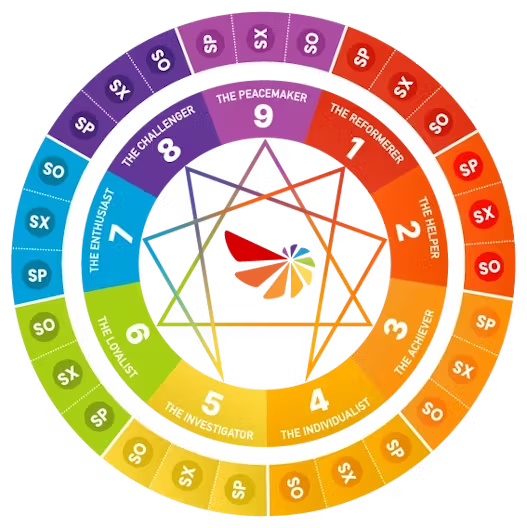
The Enneagram of Personality finds its structural origin in the work of Oscar Ichazo, the Bolivian philosopher and founder of the Arica School. While the Enneagram symbol itself was introduced to the West by G.I. Gurdjieff, it was Ichazo who, in the 1950s and 60s, first synthesized the symbol with the psychological categories we use today.
The Great Synthesis
Ichazo populated the Gurdjieffian diagram with the nine "Passions" (emotional drives) and "Fixations" (mental rigidities). In doing so, he identified and named these core points by drawing upon a vast array of wisdom traditions, specifically the "Vices and Virtues" of the Christian Desert Fathers and the combinatorial logic of the 13th-century philosopher Ramon Llull.
Clarifying the Contribution
It is important to note that Ichazo did not author the detailed character descriptions of the nine types used in modern psychology. Instead, he himself termed his system "Protoanalysis"—implying a "preliminary" analysis. He provided the geometric architecture of the ego, identifying the primary spiritual "blocks" at each point, which provided the essential framework that made all subsequent psychological developments possible.
The Nature of the Discovery
Contrary to myths of supernatural revelation, Ichazo was explicit that the system did not come from "divine intervention". Instead, he described his insight as the result of "intense study and densification" and subsequent intuition—a synthesis of theology, philosophy, science, and intuitive knowledge.
We acknowledge Oscar Ichazo as the originator of the Enneagram model of personality structure. His visionary synthesis provided the essential framework that made all subsequent developments possible.
For further context, we recommend reading Oscar Ichazo’s "Letter to the Transpersonal Community."
The psychological depth and clinical understanding of the Enneagram system presented here draws significantly from the groundbreaking work of psychiatrist Claudio Naranjo, MD. As the first person to systematically bridge modern psychology with the Enneagram symbol, Naranjo is the true architect of the personality descriptions we use today.
The Origin of the Nine Types
While Oscar Ichazo provided the structural map ("Protoanalysis"), it was Naranjo who originated the detailed psychological profiles of the nine types. During his seminal "SAT" groups in Berkeley in the 1970s, he translated Ichazo’s spiritual categories into the language of clinical psychology, aligning them with Western diagnostic criteria.
Naranjo described the birth of these descriptions through a process he termed "automatic writing." As clarified by Enneagram researcher Katherine Fauvre—who studied with Naranjo in the 1990s—this was a process of spontaneous synthesis. Naranjo leveraged his "densified" expertise as a psychiatrist to rapidly associate Ichazo’s nine points with established clinical typologies from researchers like Karen Horney, Erich Fromm, and William Sheldon. He then rigorously validated these profiles through years of observation and field-testing.
(For a detailed exploration of this terminology, see Katherine Fauvre's research: Claudio Naranjo on Automatic Writing)
The Transmission of the Work
Virtually all modern Enneagram literature derives from this period. Teachers such as Helen Palmer and Don Richard Riso built their systems upon the foundational insights transmitted—often as an oral tradition—during these early Naranjo retreats. His definitive text, Character and Neurosis: An Integrative View (1994), remains the bedrock of the modern Enneagram movement.
The Key to Understanding the Lineage
To understand the evolution of this system, we distinguish between the Structure and the Psychology:
The Pi9 Purpose Intelligence® methodology integrates both: the structural integrity of Ichazo’s map and the psychological depth of Naranjo’s clinical profiles, refined by our own contemporary research and strategic application. We encourage exploration of Claudio Naranjo's original works to understand the authentic source of modern Enneagram psychology.
The ability to freely discuss and teach the Enneagram system today owes much to Helen Palmer's pivotal role in making this knowledge accessible to the public. As one of the earliest teachers of the Enneagram in the United States and author of the groundbreaking book "The Enneagram: Understanding Yourself and the Others in Your Life" (1988), Palmer's contribution extends far beyond her teachings.
In a landmark case during the early 1990s, Palmer successfully defended against the Arica Institute's attempt (unfortunately with the blessings of Oscar Ichazo) to claim exclusive rights to Enneagram teachings and its symbolic representation. Her victory in this legal battle established that the Enneagram system, including its nine-pointed star symbol and type descriptions, belongs to the public domain. This crucial legal precedent ensures that the Enneagram community can freely use, teach, and develop this system of understanding human personality and behavior.
Palmer's influence also extends to her pioneering work in developing the Narrative Tradition, a unique approach to teaching the Enneagram through panel interviews and self-discovery. As a founding director of the International Enneagram Association (IEA) that emerged from the first International Enneagram Conference at Stanford University in 1994, she has helped establish professional standards and ethical guidelines for Enneagram teaching
While our interpretations and presentations of the Enneagram draw upon this open-source foundation that Palmer helped secure, we acknowledge her vital role in making this wisdom tradition accessible to all. We encourage exploration of Helen Palmer's original works and the Narrative Enneagram Tradition she developed in conjunction with David Daniels, MD.
The Enneagram framework presented on this website honors the complex lineage of personality studies. The detailed psychological descriptions of the nine types were originally developed by Dr. Claudio Naranjo. In the 1980s, Don Richard Riso published one of the first books on the subject based on notes from Naranjo’s oral teachings-shared by attendees without Naranjo’s authorization or acknowledgment.
For historical reference, see the 2010 Interview with Claudio Naranjo.
However, Riso and Russ Hudson subsequently made an important, independent contribution by systematizing the material. Their introduction of the Levels of Development added a dynamic vertical dimension to Naranjo’s character profiles. The interpretations presented here integrate Naranjo’s original psychological depth with Riso and Hudson’s structural frameworks, refined by our own unique methodology and research.
We encourage further exploration of the Enneagram system through Riso and Hudson's original works and The Enneagram Institute®'s extensive teachings and resources.
The subtype descriptions presented on this website draw upon the broader Enneagram tradition, which explores the nine personality types and their instinctual variations. The understanding of how instinctual drives influence personality type expression has roots in the work of various Enneagram teachers, including Claudio Naranjo's pioneering work on the instinctual subtypes.
The 27 specific subtype descriptions and their manifestations, as presented here, are significantly influenced by the extensive research and detailed descriptions developed by Beatrice Chestnut, PhD. Her work, particularly in "The Complete Enneagram: 27 Paths to Greater Self-Knowledge," has provided deep insights into how instinctual drives shape personality expression.
While the subtype descriptions presented here draw inspiration from Beatrice Chestnut's research and teachings, we have developed our own interpretations and presentations, integrating this knowledge with our unique understanding and experience.
We encourage further exploration of the discussion surrounding subtypes and their development through Beatrice Chestnut's original works and teachings.
The TriCenter concept presented on this website draws upon the broader Enneagram tradition, which explores the nine personality types and their interrelationships. The foundational idea of considering an individual's relationship to each of the three centers of intelligence (Head, Heart, and Gut) has roots in the work of various Enneagram teachers, including Claudio Naranjo's teachings on the instinctual subtypes.
We acknowledge the significant contributions of Katherine Chernick Fauvre, whose research into Tritype® combinations has enriched the field's understanding of how individuals may access multiple Enneagram patterns. Her pioneering work in this area has been valuable to the broader Enneagram community.
Our unique TriCenter system and the descriptions of the 27 specific TriCenter Archetypes represent our own interpretation and methodology for understanding how individuals integrate and express the three intelligence centers. This approach reflects our comprehensive view of personality integration within the Enneagram framework.
We honor the contributions of all Enneagram researchers and teachers who have explored the connections between personality types and the centers of intelligence, as this collective work has enriched our understanding of human psychology and growth.
The psychological depth and spiritual understanding of the Enneagram presented here draws significantly from Sandra Maitri's groundbreaking work. As one of Claudio Naranjo's original students in the SAT program during the early 1970s and a long-term teacher in the Diamond Approach®, Maitri has provided profound insights into the relationship between personality structure and essential qualities of Being.
Her seminal work "The Spiritual Dimension of the Enneagram: Nine Faces of the Soul" (2000) and "The Enneagram of Passions and Virtues" (2005) have brought unprecedented depth to understanding how each Enneagram type represents a particular relationship with and loss of specific essential qualities. Her work illuminates the connection between the nine types and their corresponding emotional patterns, passions, and virtues.
Through her teaching at the Diamond Approach® and her extensive writing, Maitri has made significant contributions to understanding the relationship between ego structures and spiritual qualities, the psychological mechanisms of each type's fixations, and the path from personality to essence for each type. Her detailed exploration of the passions and virtues has provided a sophisticated framework for understanding personality as it relates to spiritual development.
While our presentations draw upon Maitri's profound insights into the spiritual dimension of the Enneagram, particularly through her work connecting psychological patterns with essential qualities, we have developed our own interpretations and applications, integrating this knowledge with our unique understanding and experience.
We encourage exploration of Sandra Maitri's original works through her books and the Diamond Approach® teachings for a deeper understanding of the spiritual dimensions of the Enneagram.
The understanding of instinctual biases and their impact on personality presented here draws significantly from the innovative work of Mario Sikora. His reconceptualization of the instinctual subtypes, introducing the terms PRESERVING, NAVIGATING, and TRANSMITTING, has provided a clear, precise framework for understanding how our instinctual drives influence behavior.
Through his work at Awareness to Action International and his comprehensive book "Instinctual Leadership: Working with the 27 Subtypes of the Awareness to Action Enneagram," co-authored with María José Munita, Sikora has developed a practical, business-oriented approach to the Enneagram that emphasizes observable behavior rather than psychological speculation. His systematic research and real-world application of instinctual biases, particularly in organizational and leadership contexts, has brought new clarity to how these drives manifest in professional environments.
Sikora's contribution extends beyond terminology. His detailed analysis of instinctual sequences and their impact on attention, behavior, and interaction styles, as presented in "Instinctual Leadership," has provided valuable insights into how these patterns influence decision-making and leadership. The collaboration with Munita has further enriched this work through her extensive experience in Latin America and international business contexts.
While our presentations draw upon Sikora's innovative framework and terminology for understanding instinctual biases, we have developed our own interpretations and applications, integrating this knowledge with our unique understanding and experience.
We encourage exploration of Mario Sikora's original works through Awareness to Action International and his book "Instinctual Leadership," which provides a comprehensive guide to working with the 27 subtypes in professional development.
Dr. Khaled ElSherbini's unique ability to dramatize complex Enneagram constructs helps students not just understand but truly 'feel' these intricate concepts.
The understanding of Enneagram applications in consciousness studies and integral psychology presented here draws significantly from ElSherbini's innovative work. As the founder of Enneagram Egypt, the first and largest IEA-accredited Enneagram school in North Africa and the Middle East, his contribution has been instrumental in bringing structured Enneagram education to the region.
Through his work at The Consciousness Academy and his development of programs such as "Awaken through Enneagram," "Integral Enneagram," and "Conscious Coaching with the Integral Enneagram," ElSherbini has created a unique synthesis integrating the Enneagram with Spiral Dynamics, Integral consciousness studies, and transpersonal psychology.
We encourage exploration of ElSherbini's work through The Consciousness Academy and Enneagram Egypt's educational programs.
Swami Sridharananda serves as the Minister-in-charge of the Vedanta Centre of Sydney, a branch of the Ramakrishna Order founded by Swami Vivekananda. The author first met Swami Sridharananda in September 2011 at the Vedanta Society of Toronto, where Swamiji was giving an introductory talk on the Bhagavad Gita.
During this visit, the author, Stef Becker (Sadashiva), expressed his deep desire to find his guru. Swami Sridharananda compassionately included this aspiration in his evening prayers. A few months later, the author met his guru, Gurumatha Amma, during her visit to Montreal where she spoke at the Hindu Mandir temple.
It was Swami Sridharananda’s profound lectures on Patanjali’s Yoga Sutras that later ignited Stef’s in-depth study and practice of this classical text. These teachings provided the essential foundation that would eventually inform his integration of the Enneagram with traditional yogic psycho-spiritual wisdom.
Gurumatha Amma is the founder and guiding light of the Sridhara Sri Gudda Center for Self Realization and ashram, located in Bangalore, India. She has been recognized as having received posthumous initiation by Sri Shreedhara Swami Maharaj, a devotee of Lord Ram and a disciple of Samarth Ramdas. Gurumatha Amma's teaches Jeevana Dharma Yoga, which is a compendium of commentaries on the Bhagavad Gita by the late renowned Kannada poet D.V. Gundappa (DVG), presenting the ancient scripture not just as a path to liberation, but as a guide for living a healthy, purposeful, and righteous life in the modern world.
While Amma does not reference the Enneagram system, her profound emphasis on managing the mind provides essential foundational insights for understanding the psychological patterns that create suffering. Her teachings on the mind's deceptive nature and the necessity of spiritual discernment offer invaluable guidance for identifying what the Enneagram framework would classify as fixated personality patterns.
As a direct disciple of Gurumatha Amma, Stef Becker (initiated as Sadashiva by Amma) has found great value in superimposing Enneagram understanding onto Amma's traditional Jeevana Dharma yogic teachings, creating a practical bridge that helps Western practitioners identify, understand and manage specific elements within their psyche that generate what Patanjali, in his foundational Yoga Sutras, describes as vrittis (mental modifications). This integration allows seekers to use personality typing as a tool for recognizing the mental patterns that Amma teaches must be recognized and brought under conscious control through right action and correct spiritual practice.
Through her devotional approach and emphasis on surrendering the fruits of action to the divine, Amma's teachings provide both the spiritual context and transformational practices necessary for transcending personality fixation and moving toward genuine self-realization.



.png)
.png)